Nail Printer Guide 2026: How They Work, Types & Buying Tips
Published August 14, 2026
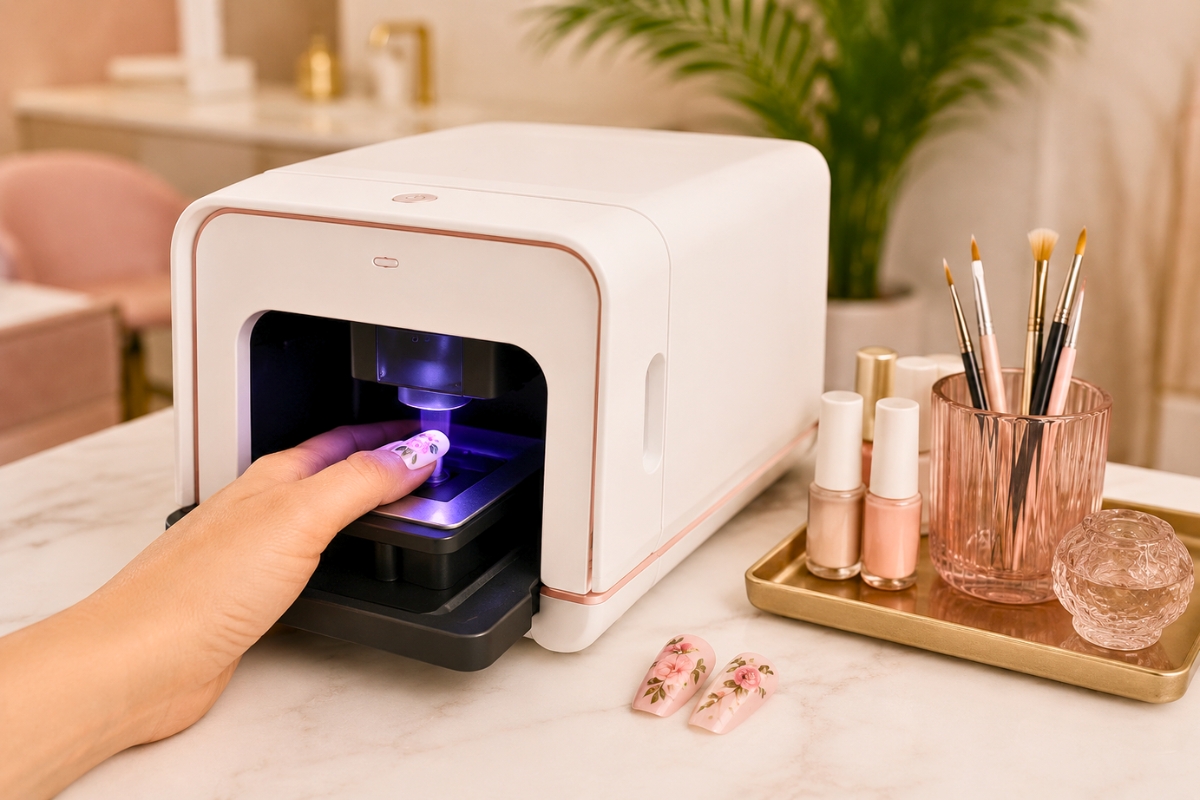
Intricate nail art doesn’t always have to be hand-painted. A nail printer can apply detailed designs directly to nails in seconds, giving salons and nail-art enthusiasts a way to create patterns, logos, and custom artwork without hand-painting every detail.
The right machine can make some types of nail art faster and more consistent, but nail printers vary in speed, resolution, design capabilities, and cost. This article covers how they work, the types available, leading models to consider in 2026, and what to look for before buying one.
What Is a Nail Printer?
Unlike a standard printer, a nail printer is designed specifically to position and apply digital artwork to the nail surface. Depending on the model, it may print one nail at a time or several nails and support different nail surfaces.
Nail printers can produce patterns, illustrations, photos, logos, and other custom artwork. Many models are designed to work with natural nails as well as gel, acrylic, or press-on nails, although compatibility varies by machine.
How Does a Nail Printer Work?
Most nail printers follow a straightforward process. The nail is prepared and positioned in the machine, a design is selected or uploaded, and the printer applies it to the nail surface. Some models use sensors or software to position and scale the design according to the nail’s size and shape.
The exact process varies by machine, so follow the manufacturer’s instructions for nail preparation, positioning, compatible materials, printing, and finishing.
What Can a Nail Printer Print?
A nail printer can reproduce a wide range of digital artwork, depending on the capabilities of the machine and its accompanying software. Designs may include:
- Patterns and decorative graphics
- Floral artwork
- Photographs
- Logos
- Illustrations
- Custom artwork
- Multi-color designs
Some machines include built-in design libraries, while others allow users to upload their own artwork through an app or other software.
Types of Nail Printers: 2D vs. 3D
Nail printers can differ in the type of design and finish they produce. This guide distinguishes between standard 2D printing and models designed to create 3D or textured effects.
2D Nail Printers
A standard 2D nail printer applies a flat design to the nail surface. This approach works well for photographs, logos, patterns, illustrations, and other detailed graphics that don’t require a raised finish.
3D Nail Printers
A 3D nail printer is designed to create nail-art designs with additional texture or dimension. Depending on the model, this may involve compatible materials or printing techniques that produce a raised or tactile finish.
Which type is right for you? A standard nail printer may be sufficient if you mainly want detailed flat graphics. A 3D nail printer may be better if textured or dimensional effects are a priority. Your choice should also reflect how often you plan to use the machine and which features the model offers.
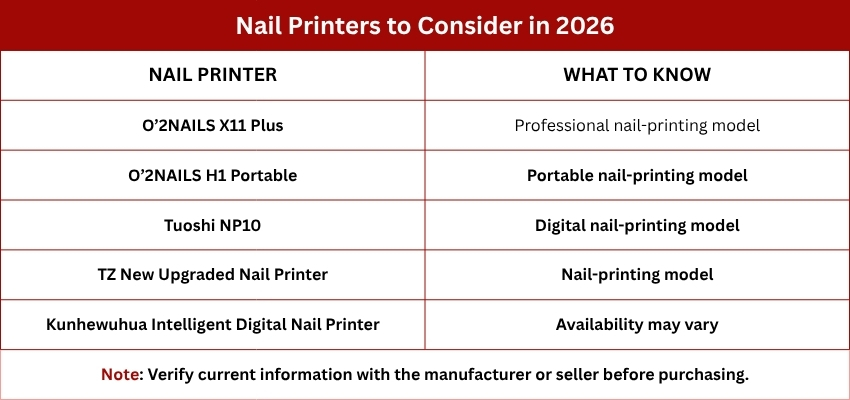
Nail Printers to Consider in 2026
If you’re considering a nail printer or nail art printer for a salon, nail studio, mobile service, or personal use in Florida, the right choice depends on how you plan to use it. Salon professionals may prioritize printing speed, workflow, and supply availability, while mobile technicians may focus on portability and ease of setup.
The models below represent different options to research. Product availability, pricing, specifications, software support, and compatible supplies can change, so verify current information with the manufacturer or seller before purchasing.
How Much Does a Nail Printer Cost?
The cost of a nail printer can vary significantly depending on its printing capabilities, resolution, speed, design features, and intended use. Entry-level and portable models generally cost less, while professional machines with advanced features can require a significantly larger investment. Prices can also vary by retailer, package, included accessories, and current availability.
When comparing prices, look beyond the initial investment cost. Ink or cartridge replacements, compatible materials, software, maintenance, warranties, and replacement parts can all affect the total cost of ownership.
Costs Beyond the Initial Purchase
- Ink or cartridge replacement
- Compatible printing materials
- Software or app requirements
- Maintenance
- Replacement parts
- Warranty and technical support
A lower-priced nail printer may be attractive initially, but a more expensive model could offer features that are more useful for frequent salon use. Compare the total cost of ownership with how often you expect to use the machine before making a decision.
Can You Make Nail Art Without a Nail Printer?
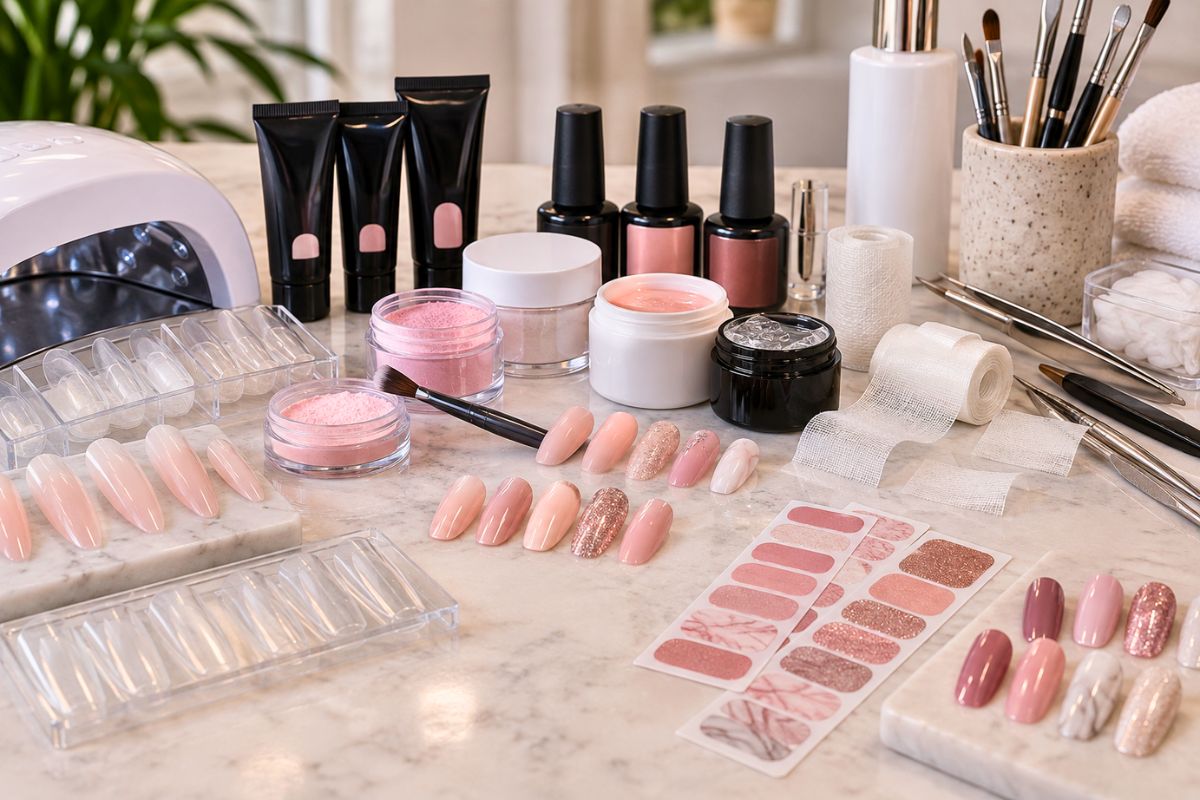
You don’t necessarily need a dedicated nail printer to create custom nail art. A standard inkjet or laser printer can be used to make DIY nail decals. Still, the process involves more manual preparation because the design must be transferred to the nail rather than printed directly onto it.
DIY decals can be a lower-cost option for occasional nail art or for people who want to experiment before investing in a dedicated nail printer.
How to Make Nail Decals With an Inkjet Printer
If you already have a standard inkjet printer, you can make nail decals using specialty waterslide decal paper and a few basic supplies.
What you’ll need:
- Inkjet printer
- Inkjet-compatible waterslide decal paper
- Photo editing software or an app
- Clear acrylic sealant spray
- Base coat and topcoat
- Scissors
Steps:
- Size your design. Resize the image to fit your nails and test the dimensions on plain paper first.
- Print the design. Use inkjet-compatible waterslide decal paper and the printer’s highest-quality or photo setting.
- Seal the printed sheet. Let the ink dry completely, then apply clear acrylic spray to help protect the design from water.
- Apply the decal. Cut out the design, soak it briefly in water, slide it from the backing, and position it over a prepared nail.
- Finish the design. Smooth out air bubbles and excess water, then apply a topcoat.
Important: Use decal paper specifically designed for inkjet printers. Inkjet ink can smear or dissolve when exposed to water if the printed sheet has not been properly sealed.
How to Make Nail Decals With Printer Paper
If you don’t have waterslide decal paper, you can make a simple nail decal using plain printer paper, clear packing tape, and a laser printer. This method requires a laser printer because laser toner is fused to the paper, while inkjet ink is water-soluble.
What you’ll need:
- Laser printer
- Plain printer paper
- Clear packing tape
- Scissors
- Base coat and topcoat
- Bowl of water
Steps:
- Print your design onto plain paper with a laser printer.
- Cover the printed image firmly with clear packing tape, smoothing out air bubbles.
- Cut around the design.
- Soak it briefly in water until the paper backing loosens, then gently remove the paper.
- Apply the decal to a prepared nail and smooth it into place.
- Trim excess tape and seal the design with a topcoat.
Important: This plain-paper method requires a laser printer. If you only have an inkjet printer, use compatible waterslide decal paper instead.
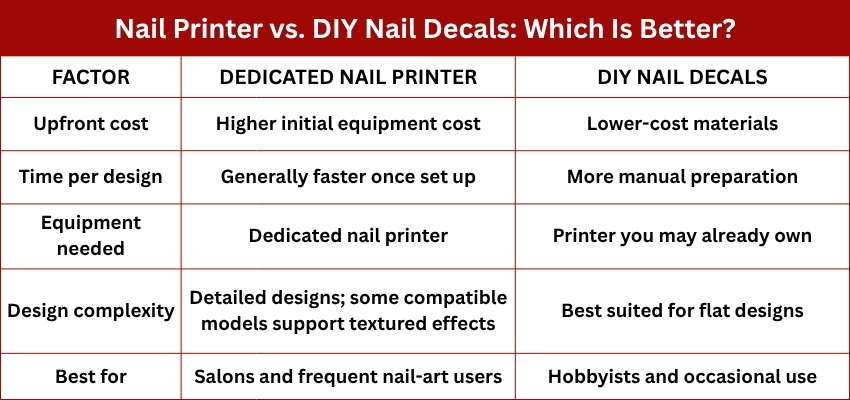
Nail Printer vs. DIY Nail Decals: Which Is Better?
A dedicated nail printer and DIY nail decals can both create custom nail art, but they’re suited to different situations. A nail printer is designed specifically for printing onto nails, while DIY decals require a standard printer and more manual preparation.
Benefits of Using a Nail Printer
For salons and nail technicians, a nail printer can offer practical advantages when detailed designs are part of the service mix.
- Faster nail-art application. A nail printer can reproduce detailed designs quickly, potentially reducing the time required for certain nail-art services.
- Custom design options. Depending on the model, you may be able to choose from built-in designs, upload your own artwork, or create personalized designs through a companion app.
- Consistent results. A nail printer can reproduce the same digital design across multiple nails, helping create a more uniform appearance.
- Greater design variety. Digital designs can provide options that may be difficult or time-consuming to reproduce by hand.
- Workflow efficiency. For salons, a nail printer can provide a repeatable process for incorporating digital designs into appointments and maintaining a consistent workflow across different services.
How to Choose the Best Nail Printer
Choosing a nail printer involves more than comparing the purchase price. Consider the machine’s print quality, speed, compatibility, design capabilities, consumable costs, software, and ongoing support.
Print Quality and Resolution
Consider how well the printer reproduces fine lines, small details, photographs, and other intricate artwork. Resolution can be particularly important if you plan to print detailed or photo-based designs.
Printing Speed
For salon use, compare how quickly the machine can print individual nails and complete designs. A faster printer may be more useful in a high-volume setting.
Nail Size and Shape Compatibility
Check the printer’s supported nail dimensions and whether its positioning system accommodates the nail sizes and shapes you typically work with.
Design Libraries and Custom Uploads
Look for a nail printer with the design options you need, whether that’s a built-in library, custom image uploads, or app-based design tools.
Ink and Consumable Costs
Compare cartridge capacity, replacement prices, and other consumables instead of looking only at the initial machine cost.
Ease of Use
A straightforward interface can reduce the learning curve and make it easier to incorporate a nail printer into a busy salon workflow.
Software and Device Compatibility
Check whether the printer’s app or software works with the phones, tablets, and operating systems you plan to use.
Maintenance and Support
Consider manufacturer support, warranty coverage, cleaning requirements, replacement parts, repair options, and the availability of compatible supplies in the U.S. before buying.
Are Nail Printers Worth It?
A nail printer is most likely to be worthwhile when you use it regularly enough for the time saved on detailed designs to justify the machine and consumable costs. For occasional users, the investment may be harder to justify.
When a Nail Printer Makes Sense
A nail printer may be worth considering if you:
- Run a busy salon
- Offer custom nail-art services
- Frequently create detailed designs
- Want to reproduce digital artwork or logos
- Need a faster option for certain designs
When You May Not Need a Nail Printer
A dedicated machine may be unnecessary if you only create nail art occasionally, prefer hand-painted designs, or are still deciding whether printed nail art is right for you. In those cases, a dedicated machine may not be necessary.
Do’s and Don’ts of Nail Printers
Do’s
- Follow the manufacturer’s instructions for nail preparation, compatible materials, cleaning, and operation.
- Clean and maintain the machine regularly.
- Test designs and positioning before applying them to clients.
- Use only compatible inks, gels, papers, and other materials.
Don’ts
- Don’t rush nail placement.
- Don’t use materials that aren’t approved or specified for your printer.
- Don’t skip routine maintenance.
- Don’t assume every nail shape or size is compatible with every machine.
Frequently Asked Questions
What is a nail printer?
A nail printer is a specialized device that applies digital designs directly to the surface of a nail. Depending on the model, it may print patterns, images, logos, photographs, and other custom artwork.
How does a nail printer work?
A typical nail printer requires the user to prepare and position the nail, select or upload a design, and allow the machine to print the design onto the nail surface. Some models use sensors or software to help position and scale the design.
How much does a nail printer cost?
Nail printer prices vary by model, capabilities, speed, resolution, and intended use. Entry-level and portable models generally cost less than professional machines with more advanced features. Prices can also vary by retailer, package, included accessories, and current availability.
Can a nail printer print custom designs?
Many nail printer machines allow users to upload personal photos, artwork, logos, or other custom designs through a companion app or software. Available features vary by model.
Can a nail printer be used on gel or acrylic nails?
Many nail printers are designed to work with different nail surfaces, including natural nails, gel nails, acrylics, and press-ons. Compatibility varies by model, so check the manufacturer’s specifications before use.
What’s the difference between a 2d and 3d nail printer?
A 2D nail printer produces flat designs, while a 3D nail printer can create additional texture or dimension. Your choice depends on the type of nail art you want to produce.
How long does nail printer art last?
The longevity of printed nail designs depends on the products used, nail surface, finishing coat, application technique, and normal wear. Actual results can vary, so follow the manufacturer’s recommendations for the printer and finishing products you use.
Can you make nail art without a nail printer?
Yes. You can create DIY nail decals using a regular inkjet printer with compatible waterslide decal paper or a laser printer with plain paper and clear packing tape. These methods require more manual preparation than using a dedicated nail printer.
Choosing the Right Nail Printer for Your Needs
Choosing a nail printer ultimately comes down to how often you’ll use it, the types of designs you want to create, and the features that fit your workflow. Compare print quality, speed, nail compatibility, consumable costs, and ease of use before committing to a machine.
If you’d prefer to have your next manicure or nail-art design done by a professional, Salon Suites Palm Beach offers a convenient way to explore local beauty services and connect with a salon professional.
Lease Salon Space In Royal Palm Beach Florida
Fulfill your dreams and be your own boss when you lease salon space in Palm Beach Florida with us. Our beautiful salon spaces come with complimentary laundry and cleaning services and a flexible lease agreement you can afford. Our salon suites come with many amenities including free cleaning service, televisions, storage space, and more. Contact us now to book a tour or learn more.

Fact Checked By Experts
Our team of internal experts diligently fact-checked this content to ensure accuracy and reliability. Find detailed information about the rigorous editorial standards we uphold for our website.

About The Author
Hi, I’m Corinne Grace, a nursing graduate from Riverside College and a passionate fan of the beauty industry. Through my professional background and experience, I write to help independent stylists and beauty entrepreneurs run healthier and more profitable businesses.